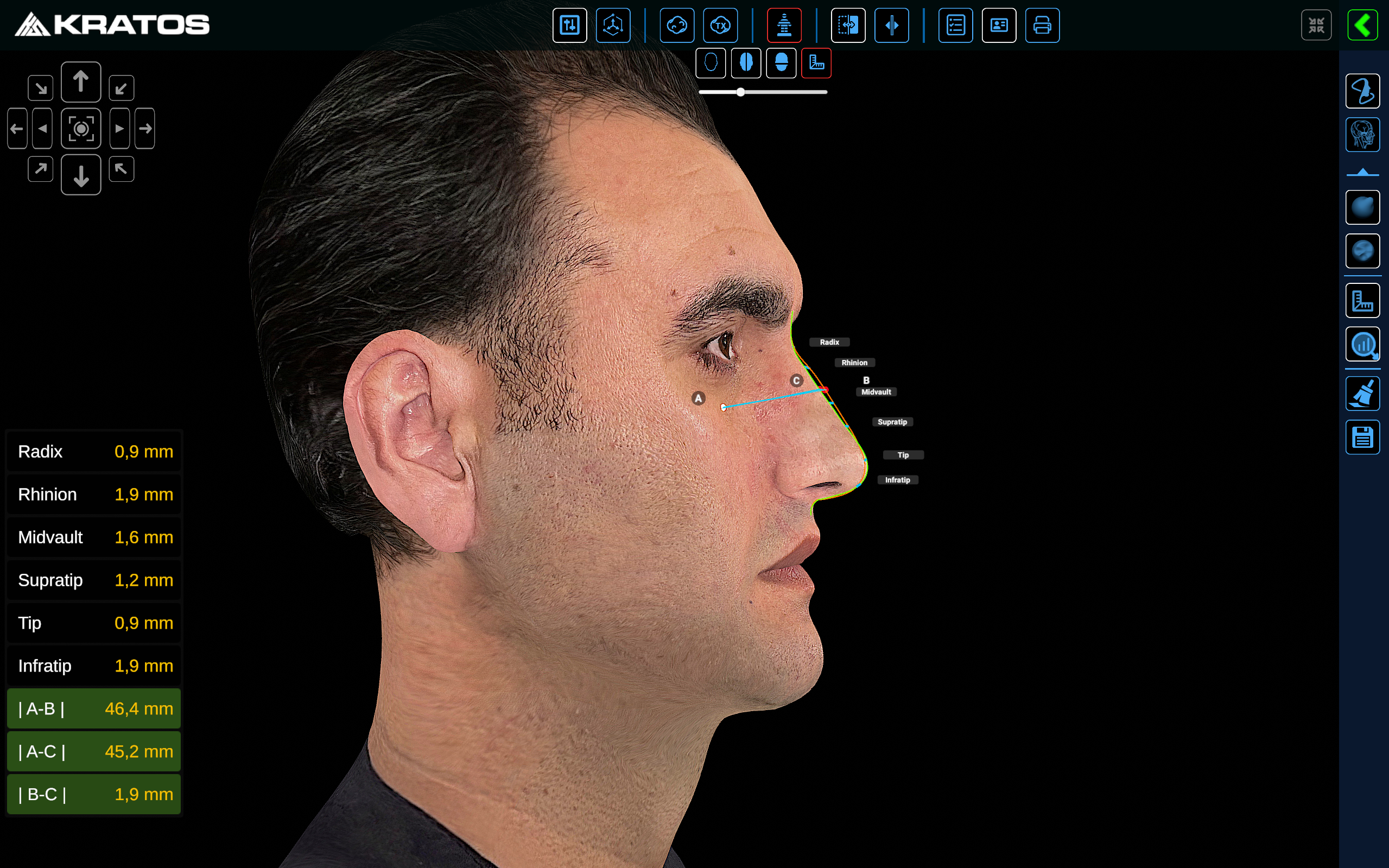
3D facial scanning for surgical planning can be done two ways: with a dedicated hardware scanner installed in a clinic (such as Vectra H2 or Artec), or with a smartphone camera and AI-based reconstruction software (such as Kratos Surgery). Both produce a 3D model of the face; they differ in cost, portability, and where the scan can take place.
How Does Hardware-Based Scanning Work?
Hardware scanners use multiple synchronized cameras (stereophotogrammetry) or structured light, mounted in a fixed rig, to capture the face from several angles at once and reconstruct a 3D mesh. This produces high geometric accuracy but requires the patient to be physically present at a clinic that owns the equipment, and the equipment itself typically costs tens of thousands of dollars.
How Does Smartphone-Based Scanning Work?
Smartphone-based platforms capture a short video or a sequence of photos with a standard phone camera, then use AI photogrammetry to reconstruct a 3D mesh and texture. Kratos Surgery, for example, generates a clinical-grade scan in about 20 seconds of capture time and roughly 10 minutes of processing, with no additional hardware. The patient can do this before ever visiting the clinic.
Which One Is More Accurate?
Dedicated multi-camera hardware has traditionally set the accuracy benchmark for clinical 3D imaging. Modern AI-based smartphone reconstruction has narrowed this gap significantly for surgical planning use cases (angle measurement, symmetry analysis, before/after comparison). For rhinoplasty and facial aesthetic planning specifically, millimetric measurement accuracy from smartphone capture is now sufficient for pre-operative planning in published clinical validations.